ERCP procedure video — performed by Pr. Ait Errami
This video shows an authentic ERCP procedure performed by Pr. Adil Ait Errami at the Digestive Endoscopy Unit of CHU Mohammed VI, Marrakech.
What is ERCP?
ERCP (Endoscopic Retrograde Cholangiopancreatography) is an advanced endoscopic procedure that allows the physician to explore and treat diseases of the bile ducts and pancreas without surgery. It combines upper digestive endoscopy with real-time X-ray imaging (fluoroscopy).
The endoscope is introduced through the mouth into the duodenum. A thin catheter is then inserted into the bile duct to inject contrast dye, making the biliary tree visible on screen. The physician can then act directly: extract stones, dilate a stricture, or place a biliary stent.
Who needs ERCP?
Your physician may recommend ERCP if you have one of the following conditions:
Gallstones lodged in the common bile duct, causing pain, jaundice or fever (cholangitis).
Yellow skin and eyes (jaundice) caused by a blocked bile duct from a stone, tumor or stricture.
Narrowing of the bile duct — benign (post-surgical, PSC) or malignant (pancreatic cancer, cholangiocarcinoma).
Pancreatitis caused by a gallstone migrating into the pancreatic duct.
Chronic pancreatitis, pancreatic duct stones, Wirsung stricture, pancreatic fistulas.
Biliary stent placement to drain bile in inoperable pancreatic or biliary tumors.
How is ERCP performed? — Step by step
-
1Pre-ERCP consultation
Pr. Ait Errami meets you in consultation to explain the procedure, obtain your informed consent, prescribe blood tests and adjust your current medications (anticoagulants, etc.).
-
2Admission and preparation
On the morning of the procedure, you are admitted to the Endoscopy Unit at CHU Mohammed VI. An intravenous line is placed. The anesthesiologist reviews your file and explains the sedation or general anesthesia.
-
3Anesthesia or deep sedation
You are put to sleep (general anesthesia) or deeply sedated for your comfort. You feel nothing and will have no memory of the procedure.
-
4Insertion of the duodenoscope
The endoscope is gently guided through the mouth, esophagus, and stomach into the duodenum. Under fluoroscopy, Pr. Ait Errami locates the opening of the papilla of Vater, where the bile and pancreatic ducts open.
-
5Cannulation and contrast injection
A thin catheter is inserted into the bile duct. Contrast dye is injected, making the biliary tree visible in real time on the fluoroscopy screen. The physician confirms the diagnosis and precisely locates the problem.
-
6Therapeutic procedure
Depending on the condition: sphincterotomy (cutting the sphincter to open the duct), stone extraction using a balloon or Dormia basket, balloon dilation of a stricture, or stent placement (plastic or metal biliary stent).
-
7Recovery room
After the procedure (20–90 min), you are transferred to the recovery room. Monitoring continues for 2 to 6 hours: pulse, blood pressure and, if needed, pancreatic enzyme levels at 4 hours.
-
8Discharge
If there are no complications, discharge is the same evening or the next morning. An escort is mandatory. Pr. Ait Errami gives you home monitoring instructions and warning signs to watch for.
ERCP vs Surgery: why choose endoscopy?
| ERCP (Endoscopy) | Abdominal surgery | |
|---|---|---|
| Incision | ✓ None — natural route through the mouth | ✗ Abdominal incision (open or laparoscopic) |
| Procedure time | ✓ 20 to 90 minutes | 1 to 3 hours |
| Hospital stay | ✓ Same-day or 1 night | ✗ 3 to 7 days |
| Recovery time | ✓ 24 to 48 hours | ✗ 2 to 6 weeks |
| Post-procedure pain | ✓ Mild abdominal discomfort | Incision pain, prolonged pain medication |
| Return to work | ✓ 2 to 3 days | 3 to 6 weeks |
| Success rate | ✓ Definitive in 95% of cases | Definitive |
How to prepare for ERCP
- Strict fasting for 6 hours before the procedure — no food or drink (essential medications with a very small sip of water are permitted).
- Blood tests: CBC, coagulation tests (PT, aPTT), blood group, creatinine, liver function tests. Required within 7 days before.
- Anticoagulants and antiplatelet agents (Warfarin, Clopidogrel, Aspirin…): temporary suspension per Pr. Ait Errami's instructions. Never stop without medical advice.
- Escort required: someone must drive you home after the procedure. You cannot leave alone or drive.
- No driving on the day of the procedure due to residual sedation.
- Documents to bring: health insurance card, recent blood test results, imaging reports (ultrasound, MRI, CT scan).
- Report any known allergy, especially to iodine (contrast dye).
After ERCP: what to expect
2 to 6 hours in the recovery room. Vital signs monitored. Blood tests may be drawn 4 hours post-procedure to check pancreatic enzymes.
Start with fluids, then light food progressively. Avoid fatty foods, alcohol and spicy food for 48 hours. Normal diet from day 2 if recovery is uneventful.
Discharge same evening or next morning. Light activity within 24–48 hours. Avoid strenuous physical effort for 5 days.
Fever >38°C, severe or worsening abdominal pain, persistent nausea/vomiting, increasing jaundice, rectal bleeding: seek emergency care immediately or call +212 663 627 258.
A follow-up consultation is scheduled 2 to 4 weeks after the procedure. Additional tests may be requested (liver function, ultrasound).
Risks and complications
ERCP is safe in experienced hands. As with any invasive procedure, there is a risk of complications. Pr. Ait Errami will discuss these in detail during your pre-ERCP consultation:
- Post-ERCP pancreatitis (3–5%): inflammation of the pancreas, usually mild and resolving with a few days of medical treatment.
- Bleeding after sphincterotomy (1–2%): usually minor and controlled endoscopically during the same session.
- Cholangitis (biliary infection) (<1%): treatable with antibiotics and biliary drainage.
- Duodenal perforation (<0.5%): rare, may require surgical management.
- Allergic reaction to anesthesia or contrast dye: very rare, assessed during the pre-anesthesia consultation.
ERCP expert in Marrakech
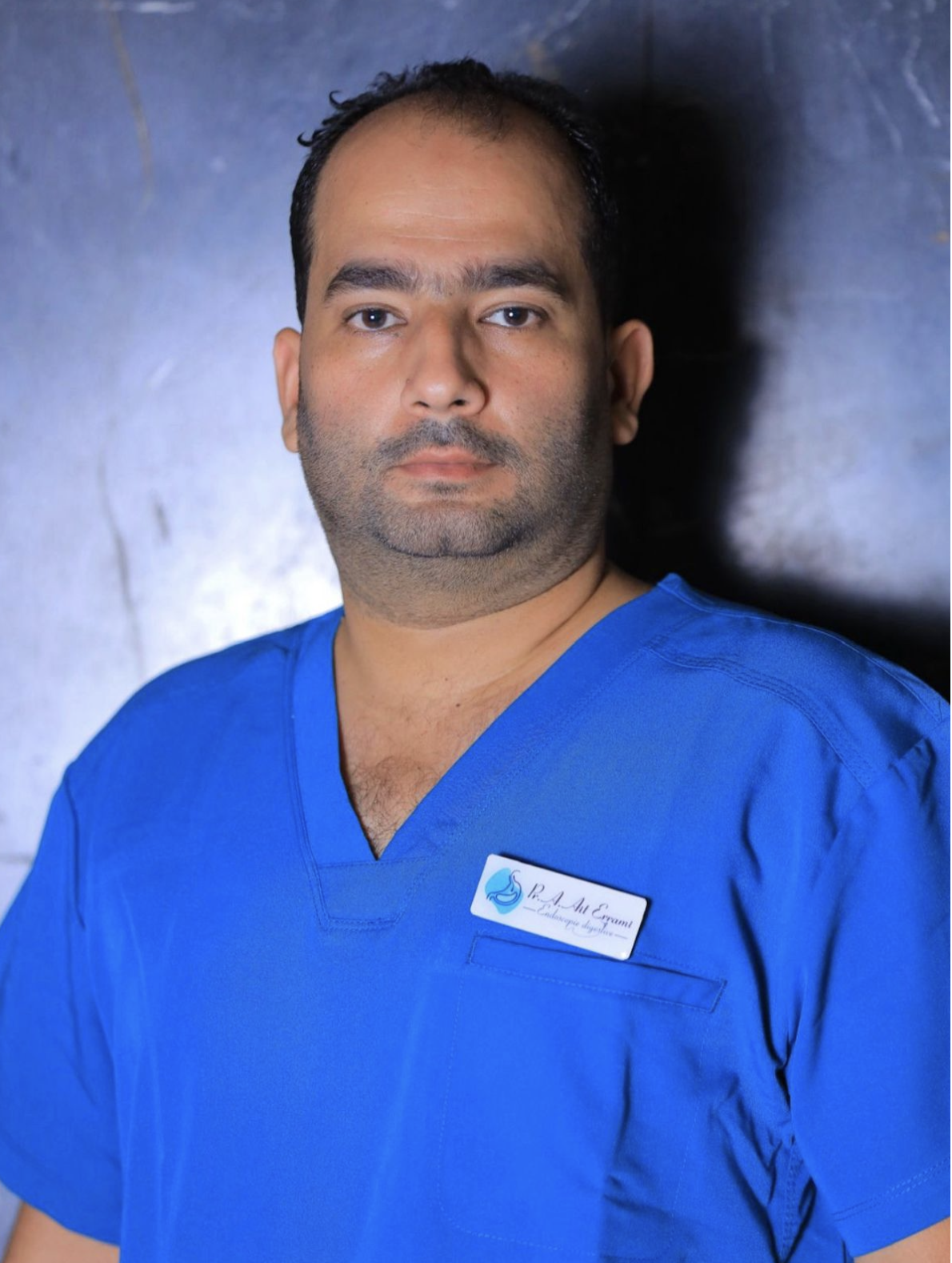
Pr. Adil Ait Errami
Gastroenterologist – Hepatologist – University Professor
Head of the Digestive Endoscopy Unit
CHU Mohammed VI · Faculty of Medicine, Cadi Ayyad University, Marrakech
Pr. Adil Ait Errami is the ERCP specialist at CHU Mohammed VI Marrakech. He received advanced ERCP training at El Kasr El Ayni University Hospital, Cairo and at European reference centers (EAGE). He performs hundreds of ERCP procedures annually, from standard indications (bile duct stones) to complex cases (malignant strictures, biliary stenting, pre-surgical ERCP).
- ERCP training at El Kasr El Ayni University Hospital, Cairo
- Member of the Young Endoscopists group, EAGE (European Association of Gastroenterology and Endoscopy)
- Interventional endoscopy training at Izmir University Hospital (Turkey), 2023 and Midas Hospital (India), 2024
- Scientific publications on ERCP and endoscopic ultrasound